REVIEW · ABU SIMBEL
Tour to Abu Simbel Temple with a small group and a Professional tour guide
Book on Viator →Operated by Tui Egypt · Bookable on Viator
That 4:00 am start is worth it. This small-group Abu Simbel day trip from Aswan takes you to Egypt’s most dramatic temple showpiece—Ramses II and Nefertiti’s twin temples—plus the yearly story of how the sun lines up inside twice a year.
What I like most is the setup for a smooth day: on-time hotel pickup and a fast drive in a clean, air-conditioned car, which helps you reach the complex early enough to dodge the worst of the crowds. I also appreciated how the process was coordinated (Mirna’s name came up in at least one smooth-day account) and that your professional guide keeps the focus on what matters in the temples, not just moving you along.
One thing to think about before you book: the day is long, and the actual on-site time can feel tight. If you want a slow, linger-at-every-stone visit, the schedule may not suit you—one 3/5 experience flagged roughly 1:45 on-site after an 8-hour round-trip day.
In This Review
- Key things to know before you go
- Abu Simbel at 4:00 am: the real start of the day
- Visiting the Ramses II and Nefertari temples (and why the twin layout matters)
- The sun’s twice-yearly alignment: the architecture has a schedule
- The gods inside the story: what the temples were dedicated to
- Small group value: attention beats rushing
- Time on site: what you should plan for at Abu Simbel
- Transport comforts on a long haul
- Price and value: $40 makes sense with the right expectations
- Who should book this Abu Simbel tour from Aswan?
- Should you book this Abu Simbel tour?
- FAQ
- What time does the Abu Simbel tour pick up from Aswan?
- How long is the tour?
- What’s included in the price?
- What’s not included?
- Does this tour use a mobile ticket?
- Is the tour dependent on weather?
Key things to know before you go
- 4:00 am pickup from your Aswan hotel for an early arrival to Abu Simbel
- Small group + professional guide so you get answers while you walk the complex
- Two temples, two royal stories: Ramses II and Nefertiti’s temple for Nefertari
- Solar alignment happens twice a year, explained in the context of the temple design
- Round-trip transfers in an air-conditioned car to keep the long day comfortable
- Entrance fees aren’t included, so budget extra for the site
Abu Simbel at 4:00 am: the real start of the day
This is an early-morning mission. The tour starts at 4:00 am, with pickup from your Aswan hotel. You’ll ride to Abu Simbel in a modern, clean, air-conditioned vehicle—exactly what you want when you’re leaving while the rest of Aswan is still asleep.
The big value of the early start is not romance; it’s timing. Abu Simbel can get crowded, and arriving earlier helps you see the temples in a calmer rhythm. One of the strongest review themes was “arrived even earlier than expected,” which is the kind of detail that matters when you’re visiting a site where the schedule drives your experience.
You’ll be in the care of a professional guide for the full day. That matters too. The temples are famous, but you’ll get more out of them when someone points out the “why” behind what you’re looking at—especially the solar alignment story.
You can also read our reviews of more tours and experiences in Abu Simbel.
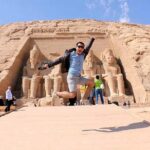
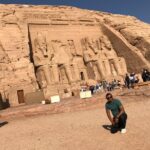
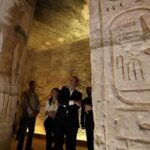
Visiting the Ramses II and Nefertari temples (and why the twin layout matters)
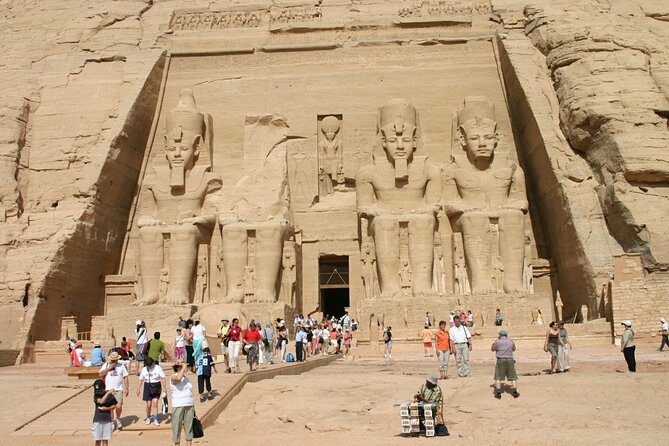
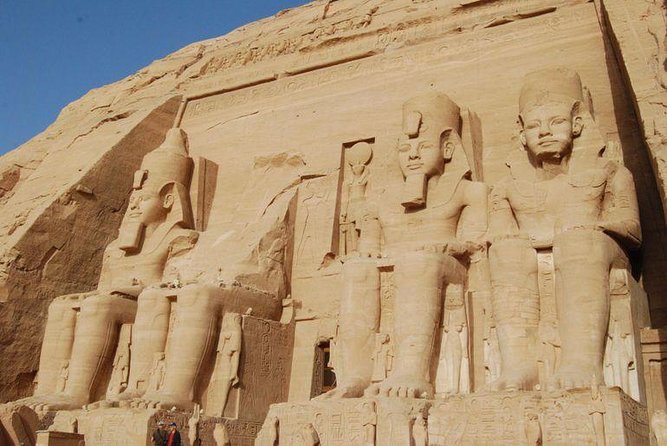
At Abu Simbel, you’re not just looking at one temple. You’re walking through a twin-temple complex carved into the mountainside in the 13th century BC during the reign of Pharaoh Ramses II.
The two temples are the core of the visit:
- The larger temple associated with Ramses II
- The temple tied to Queen Nefertiti—more precisely, the queen Nefertari is referenced in the tour description as the royal figure whose temple is part of the complex’s story
Why this twin layout is so interesting: it’s a visual way of understanding ancient Egyptian power. Ramses II’s reign isn’t only “big statue energy.” It’s organized theology, politics, and architecture working together in stone. A good guide helps you connect those dots—so you’re not just staring at impressive faces, you’re reading a whole message system.
As you explore, expect your guide to explain how the temples were built into the rock, what you’re seeing on the façade, and how the complex is structured for specific rituals—rather than as a generic monument.
The sun’s twice-yearly alignment: the architecture has a schedule
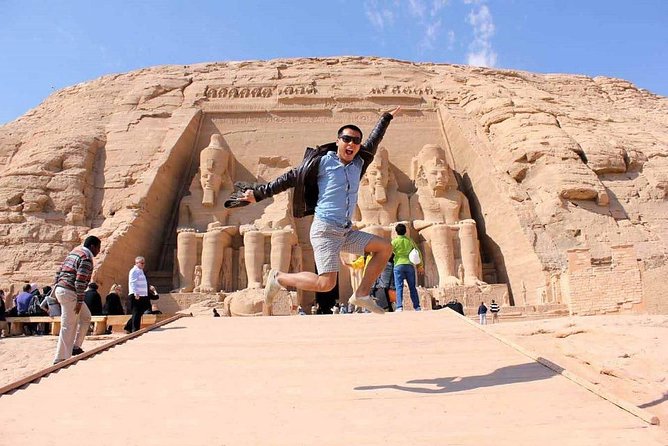
Here’s the part that keeps Abu Simbel on the “must-do” list: the temple alignment with sunlight.
Twice a year, the sun shines directly into the temple. The tour description frames this as a key feature you’ll learn about, and it’s one of those details that instantly makes the visit feel more alive. You start looking at the temple like a machine with a purpose.
Even if you’re visiting on a day when the full light show isn’t happening, the guide’s explanation helps you “see the design logic.” You’ll understand why the orientation matters, why interior spaces are arranged the way they are, and why the Egyptians would build a monument that behaves like a calendar.
If you’re the type who likes travel with a little science (sun angles, timing, intentional architecture), this is where the tour earns its keep.
The gods inside the story: what the temples were dedicated to
The tour description says the temple complex was dedicated to four key figures of ancient Egypt:
- Ptah
- Re-Her-Akhtey
- Amun-Re
- Ramses II
This is more than trivia. Knowing the dedication helps you understand why the temples are what they are: they’re religious spaces designed to connect kingship with divine authority. When your guide ties these names to the temple’s themes and layout, the complex stops being only impressive and becomes understandable.
It also makes the experience feel more “Egypt-specific.” Lots of famous ruins can be framed as general ancient history. Abu Simbel feels sharper because it’s explicitly tied to Egyptian theology and royal symbolism.
And the pro-guide angle matters here: if you only get the quick surface explanation, those names may just bounce off your brain. With a guide who keeps the facts in context, you’re more likely to remember what you saw and why it mattered.
Small group value: attention beats rushing
This tour is built around a small group, and that’s a real quality-of-life factor on a long day. The main benefit isn’t just comfort. It’s control: the guide can keep track of your questions, your pace, and what you’ve already seen.
In the high-rating experiences, smooth coordination came through clearly—especially the sense that the pickup happened on time and that the day ran without chaos. Even one account highlighted that they arrived early enough to avoid the biggest crowds. That’s a subtle win: less waiting, less stress, more temple time.
One caution: at least one low-rating review complained about organization and communication, and also claimed the group wasn’t small. So I’d treat small-group as “likely” rather than “guaranteed bliss,” and I’d plan to be flexible—especially on a tour that’s heavily dependent on early transport timing.
Still, if your priority is a guide who explains rather than just herds, this format is the right direction.

Time on site: what you should plan for at Abu Simbel
The schedule is the elephant in the room.
The tour runs about 8 hours total. That includes the ride from Aswan, the guided experience, and getting you back. One review flagged that after all that driving, there was only about 1:45 on-site to see the temple complex.
That doesn’t mean the tour is bad. It means expectations should be realistic. Abu Simbel is not the kind of place you can “shortcut” if you want to learn the story. But it is also possible to get a meaningful visit in 1–2 hours if your guide is doing their job and you’re ready to absorb quickly.
My advice: think of this as a guided highlight visit, not a slow self-guided pilgrimage. If you’re a fast walker and you love structured explanations, you’ll likely feel satisfied. If you’re the type who likes to stand and re-check details for 20 minutes at a time, you may wish you had more.
Transport comforts on a long haul
One practical plus: the transfer is described as a modern and clean air-conditioned car. That’s huge for an early start and long travel day. You don’t want to lose your energy to heat or a cramped ride before you even reach the temples.
Also, this tour includes round-trip transfers between your Aswan hotel and the Abu Simbel site. So you’re not dealing with public transport timing or separate logistics.
If you’re sensitive to long travel or early wake-ups, bring what you need for the ride: water, something for the morning chill, and a quick plan for breakfast timing (since you’ll be up early).
Price and value: $40 makes sense with the right expectations
At $40 per person, this is positioned as a budget-friendly day trip. Whether it feels like a great deal depends on what you value:
- If you want a pro guide and round-trip transfers included, the price feels reasonable for the distance and the early departure.
- If you’re comparing this to cheaper independent travel, you may be paying mainly for the guide plus the convenience of pickup and drop-off.
Two cost notes to keep you from surprises:
- Entrance fees are not included, so you’ll need extra money for the site.
- Tipping isn’t included, so you should plan to budget a little for that too.
Also, the listing mentions group discounts and a mobile ticket, which usually helps with the day’s logistics. Just keep in mind that even a smooth process can still be sensitive to timing, because the start time is so early.
Who should book this Abu Simbel tour from Aswan?
Book this if you want:
- A guided Abu Simbel visit that explains the temple story and the sun alignment twice a year
- A small-group format that’s meant to give you more guide attention
- A day trip where pickup and drop-off remove most of the stress
Rethink it if you want:
- A long, leisurely temple day with lots of unstructured time
- A low-stress plan where you can sleep in. The 4:00 am pickup is non-negotiable in practice.
This tour is also described as suitable for most travelers, and it’s near public transportation—helpful if you’re building a broader Aswan itinerary and want connections.
Should you book this Abu Simbel tour?
If you’re choosing between “I’ll do Abu Simbel somehow” and “I’ll do it with a guide,” I think this tour is a solid option—especially because the temples reward explanation. Ramses II’s complex, the Nefertari/Queen temple story, and the solar alignment facts are exactly the kind of things that can feel like random statues unless someone frames them for you.
Still, go in with two clear expectations: it’s an early start and the on-site time can be tight. If you’re okay with a guided highlight style visit, the value is strong for $40 with pickup and a professional guide.
If you hate surprises around communication and scheduling, read any details you receive at booking carefully and confirm what you need for the pickup. The mixed reviews include reports of serious miscommunication for a few people, and that’s the one risk you should respect.
FAQ
What time does the Abu Simbel tour pick up from Aswan?
The tour starts at 4:00 am, with pickup from your Aswan hotel.
How long is the tour?
The duration is about 8 hours (approx.).
What’s included in the price?
Included are pickup and drop-off to and from your Aswan hotel and a professional tour guide.
What’s not included?
Entrance fees for the historical places are not included, and tipping is also not included.
Does this tour use a mobile ticket?
Yes, the tour includes a mobile ticket.
Is the tour dependent on weather?
Yes. It requires good weather. If it’s canceled due to poor weather, you’ll be offered a different date or a full refund.